
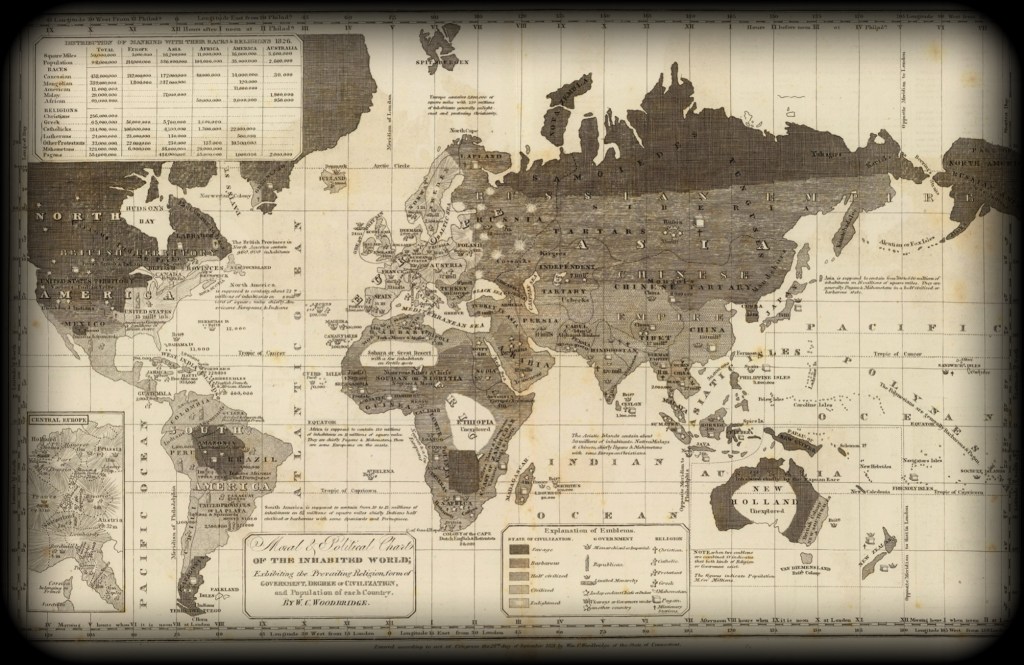
1 The date written on this physical map is 1821 – while the date of publication is registered on the website as 1837. Additionally, there appears to be an inset map representing data collected in 1826. (NB: I have doubts about the exact date this map was created or published – but it was likely created between 1821 and 1837.)
When we compare the Moral & Political Chart of the Inhabited World from 1821with the contemporary iteration of the regime of borders EUrope’s borders (well, one version of EUrope as Schengen Area), it is almost as if the gradients of the first map have been obliterated and replaced with decidedly more blunt categorizations (hence the black/whitelist).
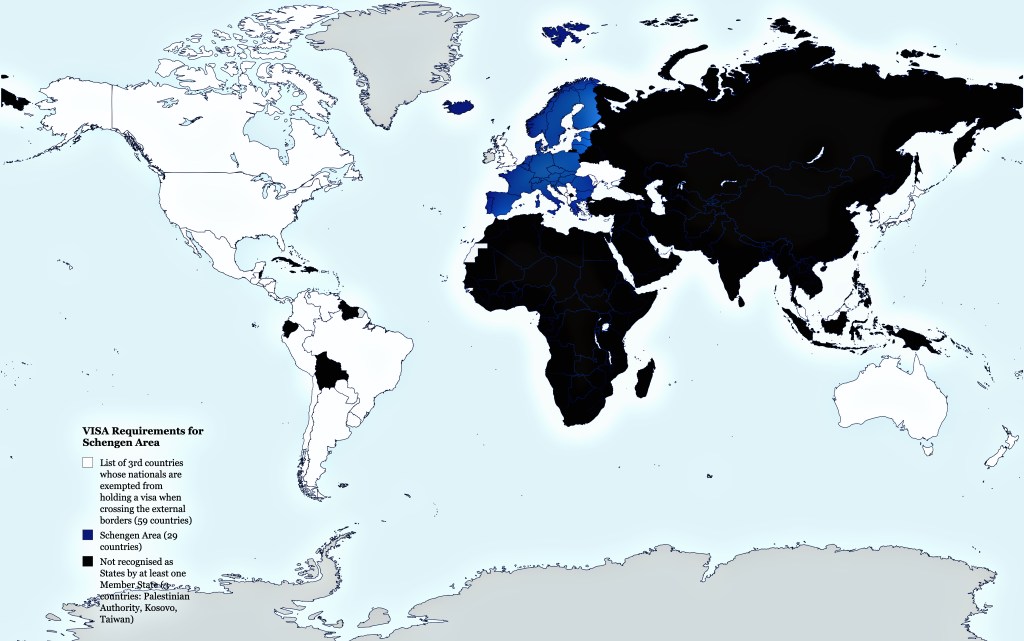
Noteworthy though, is that the experience of borders reveals that contemporary borders demonstrate a kind of a flexibility for some border-crossers. This flexibility appears to be accessible on an individual rather than on a collective level. The circumvention of borders is possible; what makes this possible, though, is the possession of useful tools or desirable capitals on the part of the border-crosser vis-à-vis the state. And the tool most useful in this case appears to be capitals associated with social class: economic, financial, social, political or human capitals. The contradiction between blunt groupings which establish an outer collective – and effectively, segregated borders to cross – with the only remedy for navigating these borders as dependent upon individual tools or a legal regime which acknowledges individual rights (and least discursively) creates a contradiction that reveals blunt and collective categorizations are somehow at odds, incompatible with the centrality of the individual, the individual (and yet potentially universal) applicability of human rights.
 deconstructing b/orders.